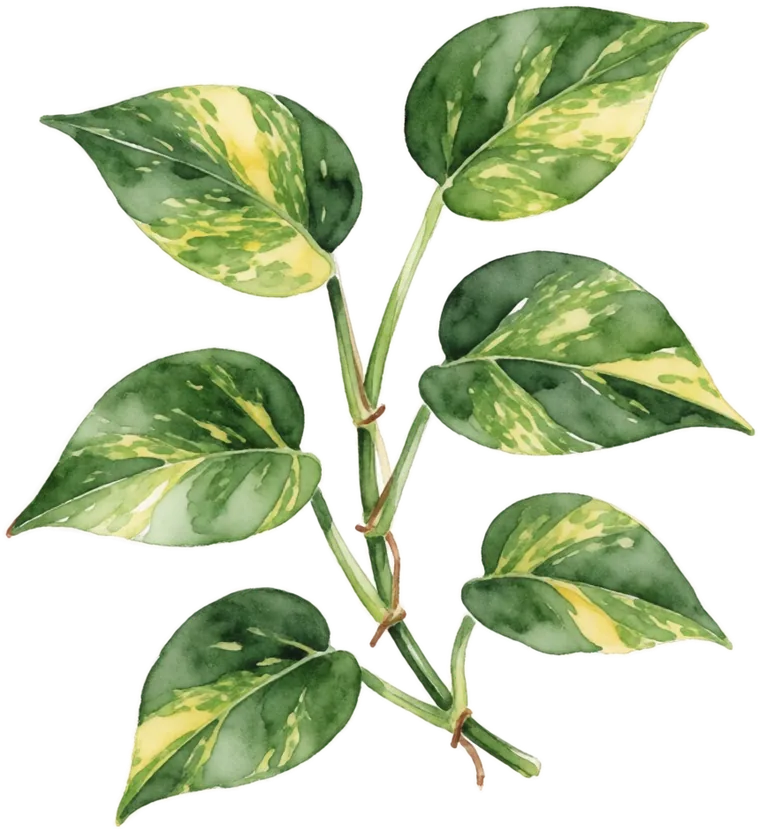
Light
It prefers bright, indirect light and survives long periods in low light. An east or west window is ideal, or a south window behind a sheer curtain. Turn the pot every week so it grows evenly.
- Too little light: the yellow markings fade and new leaves come in small.
- Direct sun: yellow or scorched leaves. Burnt patches on the pale parts of a leaf do not heal.
Water
Let the top inch of soil dry, then water thoroughly so the whole root ball is wet. Pothos is better kept a little too dry than too wet. Water less from fall through late winter, which is when overwatering rots the roots.
- Too dry: the leaves droop, and perk up again after watering.
- Too wet: black leaf edges, yellow leaves, and roots that turn brown and mushy.
Soil and pot
Use an airy, well-draining potting mix in a pot with drainage holes. Do not move it into a much larger pot: the extra soil stays wet and invites rot.
Humidity
Unlike many tropical houseplants it does not need high humidity, though it prefers 50 to 70 percent.
Warmth
It likes 70 to 85°F by day and 60 to 70 at night. Growth slows when nights drop below 65, and a few hours near 40°F leaves brown patches in the middle of the leaves. Keep it away from drafts, air-conditioning vents and heaters.
Feeding
Feed every other month in spring and summer with a general houseplant fertilizer, and not at all in winter. Leave a newly bought plant unfed for its first month.
Training and pruning
Let it trail from a shelf or hanging basket, or tie it to a moss pole that you keep damp so the aerial roots grip. On a pole the leaves grow larger.
With time the older leaves yellow and drop, leaving the leaves bunched at the ends of long bare vines. Cut the vines back just above a leaf to keep the plant bushy; it regrows even when cut to 2 inches above the soil. Wipe dust off the leaves with a damp cloth, and wash your hands after cutting, because the sap can irritate skin.
Repotting
Repot every 1 to 2 years, in spring, when roots show at the drainage holes. Go up one pot size.
Making more
Cut a piece of vine just below a leaf joint, making sure the piece has at least one joint on it, and stand it in water in a bright place. Roots form in 3 to 4 weeks. Plant several rooted cuttings in one pot for a full plant.
Pothos or philodendron?
The two look alike and are often mixed up. Look at a leaf stalk: a pothos's has a groove running along it, a philodendron's is smooth and round. A new philodendron leaf also comes out of a thin sheath that dries up and falls off; pothos has none.
When something looks wrong
Yellow leaves
Likely causeAn old leaf here and there is normal. Many at once means soil kept too wet or too dry, or direct sun.
What to doFeel the soil and correct the watering, and move the plant out of direct sun.
Brown tips or black edges
Likely causeToo much or too little water, salt build-up from fertilizer, dry air, or strong light.
What to doWater when the top inch is dry, rinse the pot through with plain water, and run a humidifier in winter.
Long bare vines
Likely causeOlder leaves drop with age, and low light stretches the gaps between leaves.
What to doCut the vines back just above a leaf and move the plant somewhere brighter. Root the pieces you cut off and plant them back in the pot.
Markings fading, new leaves small
Likely causeNot enough light.
What to doMove it into brighter, indirect light.
Drooping
Likely causeUsually dry soil. If the soil is wet, the roots are rotting.
What to doIf dry, water thoroughly and it recovers. If wet, let it dry out and check the roots: brown, mushy roots mean rot.
Brown patches in the middle of the leaves
Likely causeCold, or a sudden swing in temperature.
What to doMove it away from cold glass, outside doors and vents.
White cottony tufts, brown bumps or fine webbing
Likely causeMealybugs (white and cottony), scale (bark-coloured bumps) or spider mites. The first two leave the leaves sticky.
What to doKeep the plant apart from your others, clean it thoroughly, and spray with insecticidal soap, repeating often. For a bad case, the University of Wisconsin suggests throwing the plant out and starting again from clean cuttings.
Where this guide comes from
- Epipremnum aureum, NC State Extension Gardener Plant Toolbox
- Pothos, Epipremnum aureum, University of Wisconsin-Madison Extension
- How to Grow Pothos Indoors, Clemson Cooperative Extension Home & Garden Information Center
- Pothos as a Houseplant, Penn State Extension
- How to grow epipremnum, Royal Horticultural Society
- Epipremnum aureum, Royal Horticultural Society
- Epipremnum aureum, Plant Finder, Missouri Botanical Garden
- Cultural Guidelines for Commercial Production of Interiorscape Epipremnum, University of Florida IFAS
- Is it philodendron or pothos?, University of Illinois Extension
- Golden Pothos, toxic and non-toxic plants, ASPCA
- Mineral and Fertilizer Salt Deposits on Indoor Plants, University of Maryland Extension
- Growing Indoor Plants, Utah State University Extension
- Help for Houseplants, Utah State University Extension
- Houseplants: Temperature and Humidity, Colorado State University Extension
- Humidity and Houseplants, Penn State Extension