Light
It prefers bright, indirect light and puts up with far less: heartleaf philodendron can survive for long periods in very low light. Near a north, east or west window suits it.
- Too little light: long, spindly stems with fewer, smaller leaves.
- Too much direct sun: scorched or discoloured leaves.
Water
Water when the top inch of soil is dry, and aim for evenly moist, never soggy. Do not leave the pot standing in water. In winter growth slows right down, so water less.
- Too wet: yellow leaves, then root rot and collapse.
- Too dry: wilting.
- Not sure which? Slide the plant out of its pot. Healthy roots are white; dark brown or black roots have been too wet.
Soil and pot
Ordinary all-purpose potting mix is fine. It does not mind being a little pot-bound; a pot much bigger than the roots stays wet and rots them. Use a pot with a drainage hole and empty the saucer.
Humidity
It prefers humid air but tolerates ordinary household air better than most tropical plants.
Warmth
Keep it between 65 and 85°F; below 50°F is too cool. Keep it out of cold drafts and away from radiators and vents, and do not leave it trapped between a window and a closed curtain on a cold night.
Feeding
Feed once a month from April to September with a general liquid houseplant fertilizer, and not at all in winter. Go light: too much fertilizer is the usual cause of brown leaf tips.
Training and pruning
Let it trail from a shelf or hanging basket, or give it a moss pole or trellis to climb. The stems root into a moss pole that is kept damp.
To keep it full, pinch off the stem tips, or cut straggly stems back in spring just above a leaf joint. The aerial roots can be left, guided onto the pole, or cut off near the stem without harm. Wipe the leaves with a damp cloth now and then, and wash your hands after cutting: the sap irritates skin.
Repotting
Repot every 2 to 3 years, in spring, once the roots are packed tight. Go up one pot size, no more.
Making more
Between spring and late summer, cut a 4-inch piece of stem just below a leaf joint, strip the lower leaves and stand it in water. Roots form in a couple of weeks. Change the water often, and pot the cutting up once the roots are a few inches long.
Philodendron or pothos?
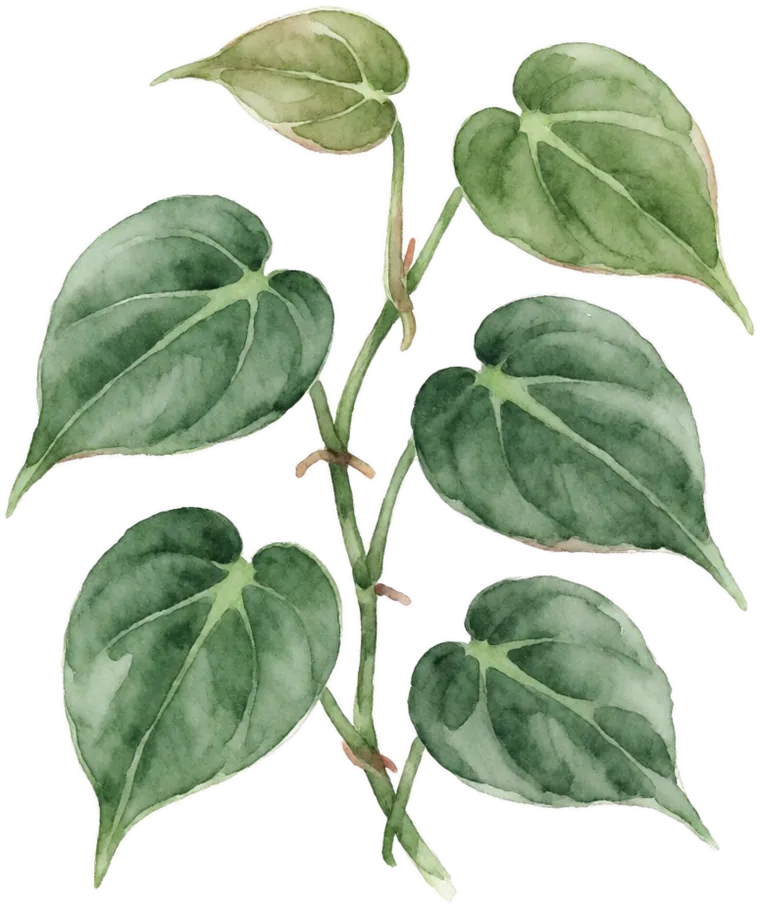
The two look alike and are often mixed up. Look at a leaf stalk: a philodendron's is smooth and round, a pothos's has a groove running along it. A new philodendron leaf also comes out of a thin sheath that dries up and falls off, and is often pinkish or brownish at first. Pothos leaves have no sheath and usually carry yellow or white flecks.
If yours grows upright
Not every philodendron trails. Self-heading kinds, such as 'Birkin', 'Xanadu' and the tree philodendron, grow as a clump of large leaves on stiff stalks from a short stem. Care is the same: medium to bright indirect light, and water when the top inch is dry. They need no pruning or support, can grow twice as wide as they are tall, and want a heavy pot so they do not tip.
When something looks wrong
Yellow leaves
Likely causeToo much water or a pot that does not drain, or too little light. An old leaf yellowing now and then is normal.
What to doLet the soil dry out, check that the pot drains, and move it somewhere brighter.
Brown leaf tips
Likely causeSalt build-up from too much fertilizer, dry air, or uneven watering.
What to doRinse the pot through with plain water, feed less, and run a humidifier in winter. Trimming the tips off does not cure it.
Long bare stems with small leaves
Likely causeNot enough light.
What to doMove it somewhere brighter. Stems that have already gone spindly stay that way, so cut them back in spring and let it regrow.
Wilting
Likely causeSoil that is either too dry or too wet.
What to doCheck the root ball. If it is dry, water thoroughly. If it is wet and the roots are dark, let it dry out.
Spots on the leaves
Likely causeLeaf-spot disease, which turns up now and then.
What to doKeep the leaves dry and give the plant more air movement.
Sticky leaves, cottony tufts, bumps or fine webbing
Likely causeInsects: aphids, mealybugs, scale or spider mites.
What to doKeep the plant apart from your others. Wipe the insects off with a cotton swab dipped in rubbing alcohol, spray the plant down with water, or use insecticidal soap, and repeat until they are gone.
Where this guide comes from
- Philodendron hederaceum, NC State Extension Gardener Plant Toolbox
- Philodendron, NC State Extension Gardener Plant Toolbox
- Philodendron hederaceum, Plant Finder, Missouri Botanical Garden
- How to grow philodendrons, Royal Horticultural Society
- Philodendron hederaceum, Royal Horticultural Society
- Philodendron, Pothos and Monstera, Clemson Cooperative Extension Home & Garden Information Center
- Common Houseplant Insects and Related Pests, Clemson Cooperative Extension Home & Garden Information Center
- Heartleaf Philodendron, University of Florida IFAS Gardening Solutions
- Hybrid Philodendrons, University of Florida IFAS Gardening Solutions
- Growing Philodendrons at Home, Iowa State University Extension
- How do I care for a philodendron?, Iowa State University Extension
- Diagnosing Houseplant Problems from Improper Environmental Conditions, Iowa State University Extension
- Is it philodendron or pothos?, University of Illinois Extension
- Keep houseplants happy with simple solutions, University of Illinois Extension
- Grooming Indoor Plants, University of Maryland Extension
- Mineral and Fertilizer Salt Deposits on Indoor Plants, University of Maryland Extension
- Heartleaf Philodendron, toxic and non-toxic plants, ASPCA
- Growing Indoor Plants, Utah State University Extension
- Help for Houseplants, Utah State University Extension
- Houseplants: Temperature and Humidity, Colorado State University Extension
- Humidity and Houseplants, Penn State Extension